
The Ring That Rules Them All: How the Bagel Conquered the World

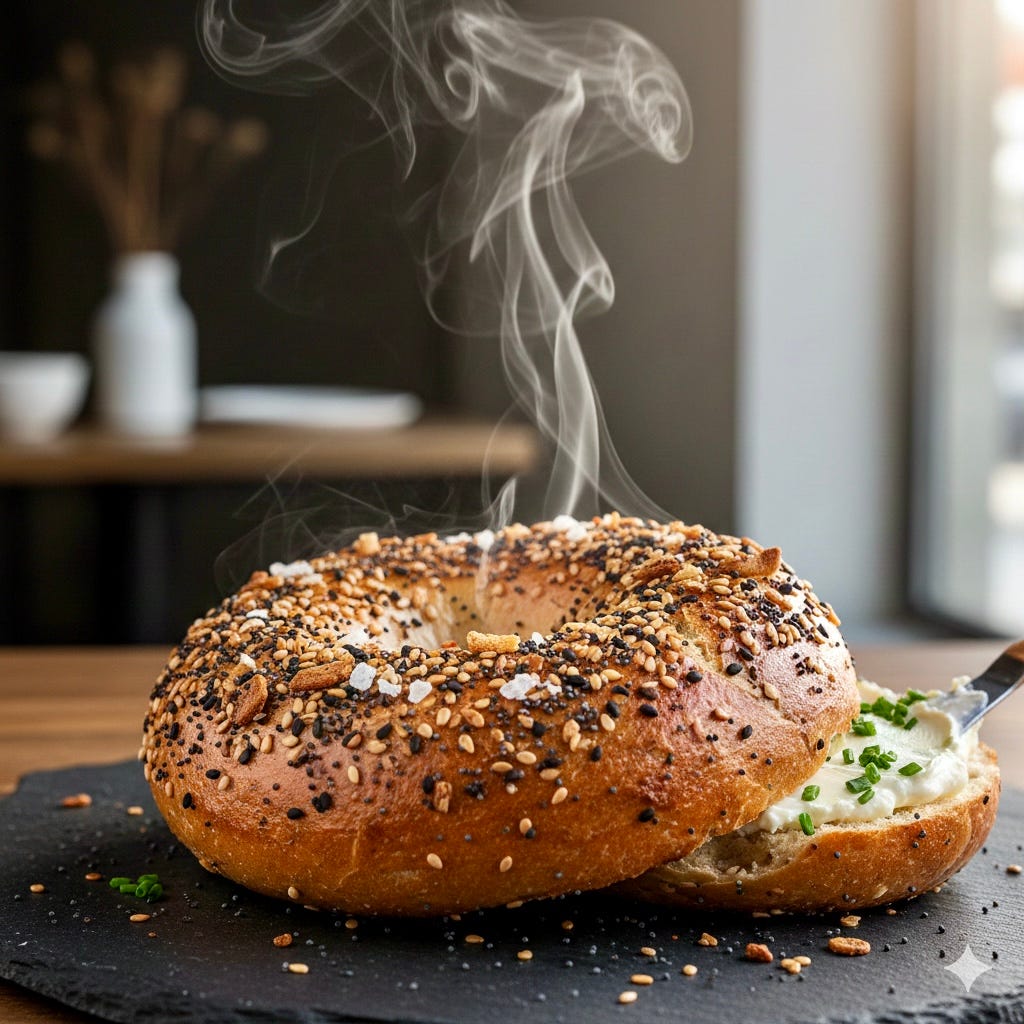
From “Rigor Mortis” to a $97 Billion Breakfast Empire
Hello everyone,
Welcome back to Culture Unpacked. After our first deep dive into the physical resurrection of high-street shopping, I wanted to look at something we often take for granted while we’re out on those streets: the food in our hands.
Specifically, the “petrified doughnut.”
It is a strange thing to witness a cultural object move from a specific, guarded tradition to a global commodity. The bagel, like the hamburger and pizza before it, has officially completed its journey from the culinary “ghetto” to the global mainstream.
If you think the bagel is just a niche bakery item, the scale of the modern market will shock you. We are no longer talking about a local deli trade; we are talking about a global titan. While the “specialty bagel” industry itself is worth billions, the bagel has become the anchor of a massive global bakery sector. In the United States alone, retail sales for baked goods—led by the breakfast sandwich revolution—are projected to hit a staggering $97.7 billion in 2026.
However, bagels remained a niche Jewish food for decades: as recently as 1960, the New York Times felt obliged to explain, inaccurately, that “a bagel is an unsweetened doughnut with rigor mortis.” To a modern ear, calling a bagel a doughnut because both are round and yeasted is like calling a savage beating a massage because both involve hands on bodies.
If Culture Unpacked brings you clarity or perspective, consider supporting the work with a paid subscription. Everything remains free — your support simply helps it continue.
The Industrialization of the “Chew”
That 1960s skepticism existed because, back then, you had to be in a city like New York or Montreal to find one. That changed when Dan Thompson’s bagel-forming machine allowed for mass production in the late 60s, but it came at a cost.
“The bagel, which had once been small, flavorful, dense, and crusty, was now precisely the opposite: huge, insipid, and pillowy soft,” notes food historian Maria Balinska. Sleeves of these “bread rolls with holes” now shiver in supermarket freezer aisles and turn up on fast-food menus.
Purists like Phil Shuman, a veteran bagel baker, still shudder at the shift: “If you don’t boil it, you’re just making a circular roll. The steam-injection ovens they use in factories kill the soul of the bread. You lose that ‘rip’ and ‘tug’ that defines the experience.”
But their popularity shows that even a bad bagel is pretty good. As Jay Rushin, CEO of the iconic H&H Bagels, points out: while the industry scales, the hunger for the “old-world process” is actually what’s driving the modern premium market.
The Global “Carb-Shock”
“We are seeing a massive ‘Westernization’ of breakfast across the Asia-Pacific region,” says Akira Han, a consumer retail analyst. “In cities like Seoul and Shanghai, the bagel isn’t just breakfast; it’s a status symbol. It represents a cosmopolitan, fast-paced lifestyle.”
Indeed, demand is skyrocketing in East Asia. To illustrate the reach: the China division of Tim Hortons reportedly sold over 22 million bagel products in a single year recently. Even the “carbphobia” of the last decade couldn’t stop it. The average American still eats nearly 40 bagels each year. We’ve simply adapted the bagel to fit our current neuroses.
“We’ve seen a 30% jump in ‘functional’ bagels,” says one Manhattan deli owner. “Ten years ago, a gluten-free bagel was a brick. Now, they’re actually edible. People want the comfort of the ritual without the guilt of the gluten.”
The Buffalo Chicken Era
Innovators have expanded beyond the traditional flavors of onion, garlic, pumpernickel, and salt. We are now in the era of the “Novelty Bagel.” We have rainbow-colored dough for Instagram, French-toast-flavored rings for the sweet-toothed, and—most controversially—the viral “stuffed” bagels. At spots like Moonrise Bagels in NYC, the dough is essentially a vessel for buffalo chicken or bacon, egg, and cheese.
As the late, great Nora Ephron once wrote: “I don’t mean to make it sound as if it’s all about being Jewish... but it makes you feel really Jewish if you can’t buy a decent bagel.”
The Final Crumb
Ultimately, the bagel’s journey is the ultimate immigrant success story. It survived the crossing from the shtetls of Poland to the Lower East Side, weathered the “rigor mortis” mockery of the mid-century elite, and outlasted the low-carb trends of the 2000s. It has evolved from a guarded community secret into a $97 billion global powerhouse that speaks every language.
Whether it’s hand-rolled in a wood-fired oven in Montreal or served through a drive-thru in Dallas, the bagel remains a symbol of resilience. It might be stuffed with spicy poultry or dyed the colors of a neon sunset, but its core remains unchanged: a simple, stubborn ring of dough that refused to be forgotten. It turns out that even when you mass-produce it, the bagel keeps its soul—one chew at a time. Not bad for a petrified doughnut.
The Bagel Boom: 2026 by the Numbers
• $97.7 Billion: The projected value of the U.S. retail bakery market in 2026, with bagels serving as a primary engine.
• $7.7 Billion: The specific global market valuation for “pure” bagel products this year.
• 22 Million: Bagels sold by a single coffee chain in China last year, proving the “Eastward” shift is real.
• 40: The number of bagels consumed by the average American annually, despite the rise of low-carb diets.
• 1610: The year of the first written record of a “bajgel” in Krakow, Poland.
George Froehlich,
Editor - Culture Unpacked
Coming Next Week on Culture Unpacked:
Move over, Georgia and Vancouver. There’s a new “North Hollywood,” and it’s south of the border. We’re heading to Mexico City, the new headquarters for global streaming giants. We unpack why the world’s biggest studios are fleeing California for the creative energy (and massive tax breaks) of Mexico, and how CDMX became the most influential cultural capital of the 2020s.
Best,
George Froehlich
Editor, Culture Unpacked